What is rights retention?
Rights retention is an initiative used by increasing number of UK universities that supports the self-archiving 'Green' route to open access.
Traditionally, when an author signs a copyright agreement, they transfer the rights of a work to the publisher. This typically gives the publisher control over how the work is distributed and reused. In return, authors are usually granted limited rights, such as using excerpts for other projects, but often publisher permission is required for other activities such as sharing with academic networks and reuse in teaching.

Article versions diagram courtesy of: https://unlockingresearch-blog.lib.cam.ac.uk/manuscript-detectives-submitted-accepted-or-published/, CC-BY
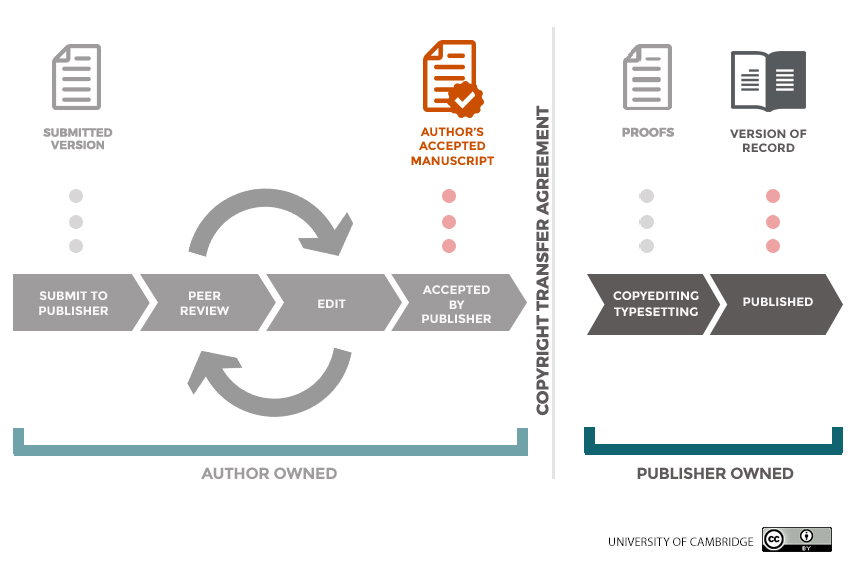
Rights Retention is a mechanism that empowers authors to automatically keep control over the rights to their Author Accepted Manuscripts (AAMs) when publishing peer-reviewed journal articles and conference papers. It recognises that researchers own the initial copyright to their AAMs, and that it is not necessary for an author to sign over their copyright or grant an exclusive licence to a publisher in order for their work to be published or disseminated. Publishers will maintain ownership of the final version of record but will not be able to impose an embargo on the AAM so authors can share this and re-use it as they choose.
How does the policy work?
Our Research Publications and Copyright Policy, enables our authors to automatically retain rights to their peer-reviewed research articles by granting Goldsmiths a non-exclusive licence to make their AAMs publicly available under a Creative Commons (CC-BY) licence without embargo via our institutional repository Goldsmiths Research Online (GRO), regardless of any subsequent agreements with their publisher.
Under the policy, Goldsmiths does not claim ownership of copyright (this is retained by the author); the right being granted is that of allowing the University to make the AAM of research articles openly available in GRO without an embargo.
We can make your manuscript immediately open access through GRO because we have contacted the most frequently used publishers at Goldsmiths of the new policy, so authors are not legally required to do anything to make use of the policy. This “prior notice” provides Goldsmiths authors with reassurance that even when they are publishing the version of record behind a paywall, the AAM can be made openly available via GRO immediately on publication.
The list of publishers we have contacted is available here. If a publisher you are considering submitting to is not on the list, please email gro@gold.ac.uk and we will contact the publisher to give them notice of the policy requirements.
Why retain your rights?
Retaining your author rights to your journal articles and conference papers means that:
- You keep ownership of the copyright to your work.
- You can make your work immediately open access on publication in our institutional repository Goldsmiths Research Online (GRO) even if the published Version of Record remains behind a subscription paywall. Without rights retention, publishers can impose embargo periods lasting several years during which an article is not open access.
- It ensures the widest possible access to your research as well as meeting REF and funder requirements where a paid 'Gold' open access option may not be possible.
- You can decide how your work will be used in the future, such using it in teaching, sharing it with colleagues and your own academic networks, and to promote it more effectively via social media.
Does the policy restrict where I can publish?
There is no restriction on choosing where to publish. The policy is intended to support author choice of publisher, so that authors can select the journal most appropriate for their research and be confident that they can meet the open access requirements for REF2029 by making their AAM openly available on GRO irrespective of any embargo periods or licensing conditions stipulated by publishers.